Harnessing the Winter Wind

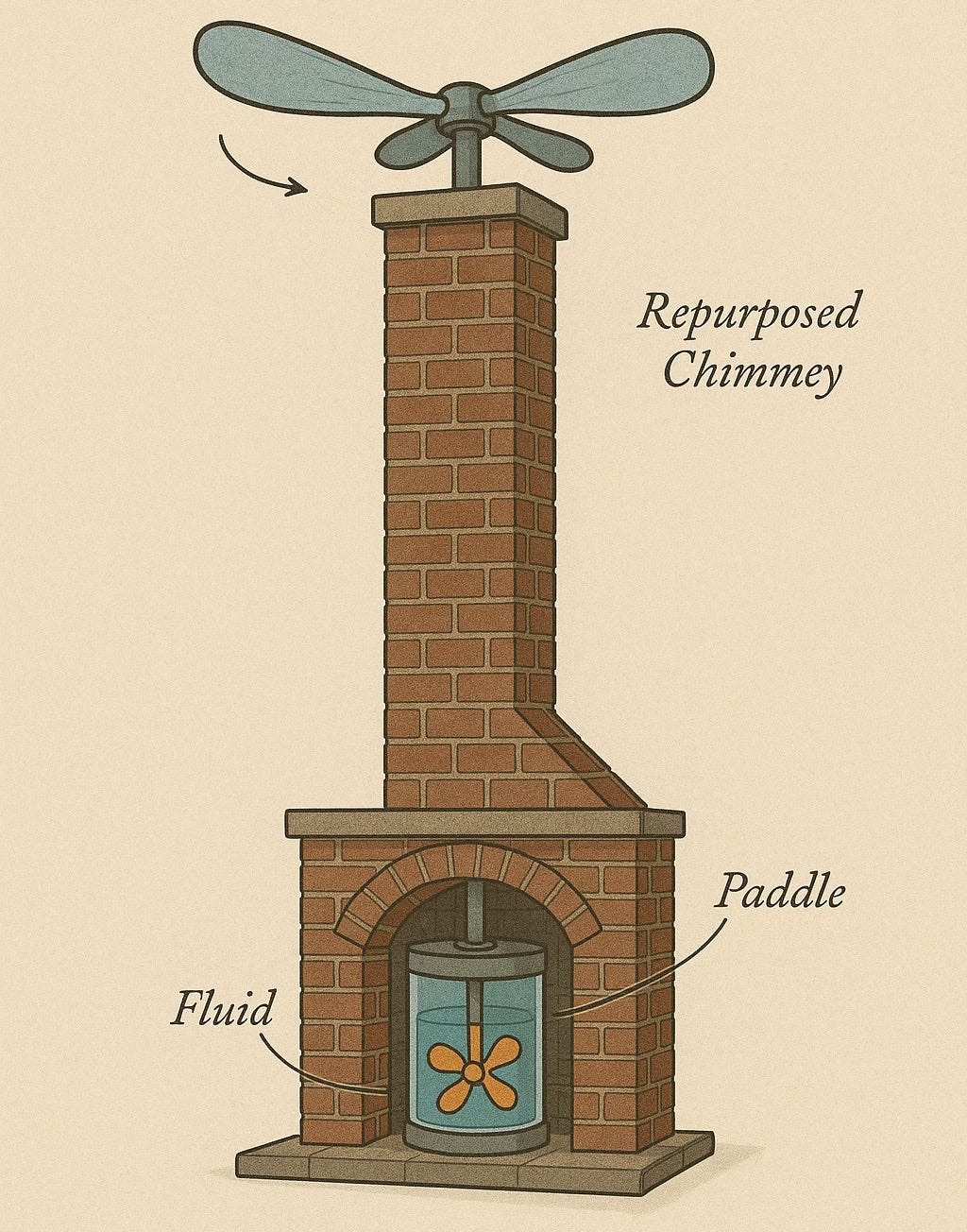
Tim Tinker wanted his house to hum—quietly, purposefully, like a machine satisfied with itself. But in the dead of winter, his home mostly groaned. The beams creaked, the windows rattled, and heaters clicked with impatience at the oil furnace that struggled to keep up with the northern wind.
It was that wind—unyielding, insistent, and free—that Tim couldn’t stop thinking about.
He’d been sitting at the window one January morning, watching snow blow sideways off the fields, when the idea struck him with such clarity that he startled his cat, Ohm.
“Heat,” he whispered. “There’s so much heat in all that force.”
Tim wasn’t new to inventing. His barn was full of half-finished contraptions—solar powered gliders, space-based power stations, smart eyeglasses. But this idea… this one felt real.
One day, while digging through engineering journals in the town library, he found it: a footnote in a dusty Danish energy report from the 1980s.
Fluid-brake turbines, they were called.
A handful of engineers on the windy coast of Jutland had experimented with them—wind turbines mechanically stirring thick, viscous fluid to generate heat directly. No generators, no wires, no inverters. Just mechanical power turned into warming friction. The idea never became a scalable product, but to Tim it felt like a forgotten treasure.
He read the paragraph three times, hardly breathing.
A rotating paddle within a sealed chamber of fluid may achieve significant resistive heating, provided sufficient torque from a wind rotor…
Tim closed the book slowly, hands tingling.
“This,” he said, “is exactly what a house like mine needs.”
It was so simple he could make it himself. He could see it: a wind rotor atop his unused chimney, a long steel shaft running down through the flue, and at the hearth—where the old fireplace bricks still smelled faintly of soot—a cylindrical chamber filled with heat-sink fluid churned by a stout paddle. The winter wind would spin the turbine, the paddle would stir the fluid, and the fluid would generate enough heat for the whole house.
Simple. Elegant. Obvious—at least to Tim Tinker.
That night he sketched the first version of what he would later call the Joules Generator. His pencil glided across the page as though it already knew the shape of the idea, as though the house had been waiting all along for someone to coax warmth from the wind itself.
Outside, the winter gusts roared across the fields as if cheering him on.