War College Conversation
"“To deter your enemy, you threaten to cut off your arm, right?”

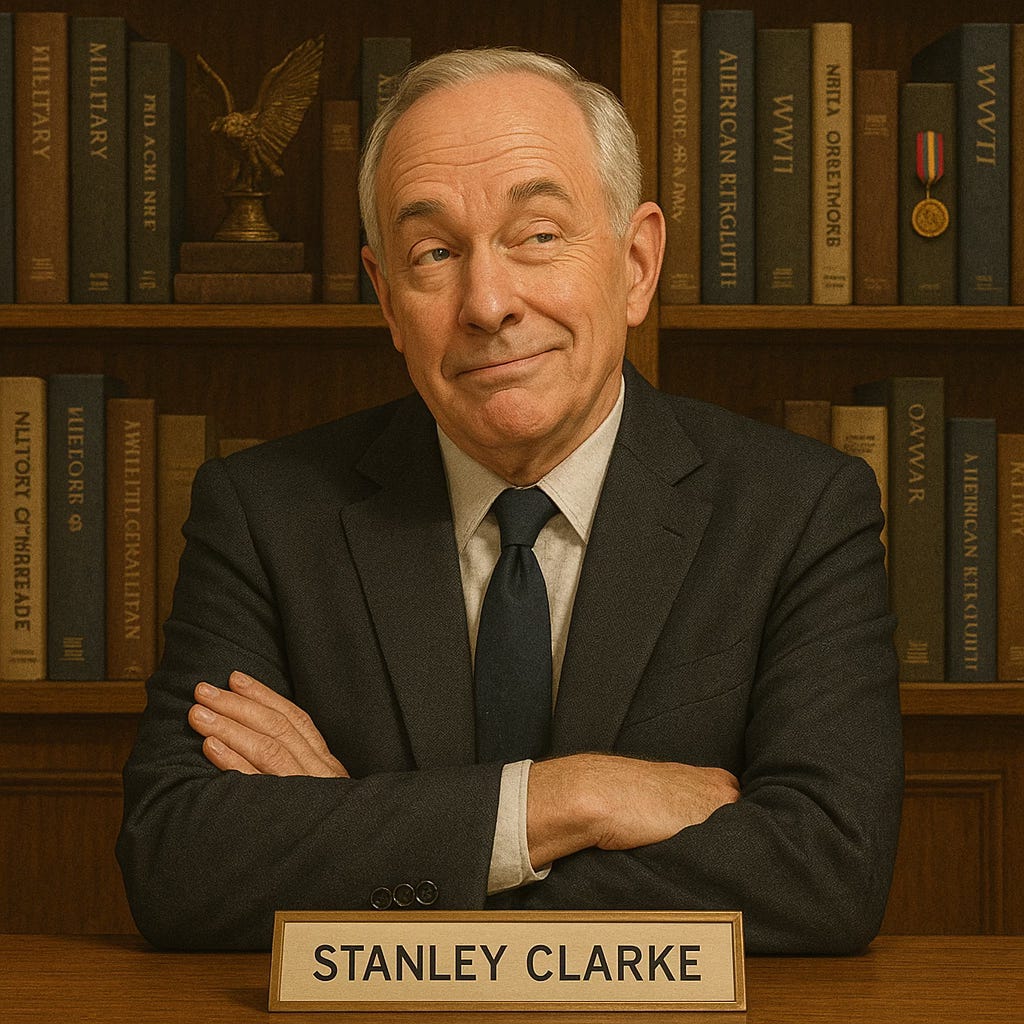
The Amtrak train rattled into Carlisle, Pennslyvania on a crisp October morning, its windows framing hills painted in autumn colors.
Warren Levinsky stepped onto the platform with a leather satchel slung over his shoulder. To a casual passerby, he might have been any mid-career academic or policy wonk visiting the U.S. Army War College. But Warren was here to sound out an old friend on the kind of contingency plans Washington analysts whispered about.
The campus itself seemed a world away from war. Broad lawns stretched out under canopies of maple and oak, their branches shimmering red and gold. Cadets and civilian colleagues strolled between stately brick buildings. Military ritual pervaded the grounds — bugle calls in the morning, the cadence of marching feet in the afternoon — but otherwise the air was tranquil, an oasis of order and thoughtfulness far removed from the escalating chaos half a world away.
That chaos was intensifying daily. In the South China Sea, China’s People’s Liberation Navy was moving like a silent tide, never quite crossing the threshold of open conflict but testing it constantly. Flotillas of Chinese fishing trawlers swarmed contested waters, their crews trained and directed by the PLA Navy. Behind them came the white-hulled ships of the Chinese Coast Guard, which had begun ramming under-equipped Philippine vessels in showdowns that left Manila’s sailors injured and humiliated.
In Taipei, the internet was blinking on and off as Chinese trawlers sliced undersea fiber lines — invisible acts of sabotage that periodically severed Taiwan’s access to the rest of the world. The message was unmistakable: Beijing could choke Taiwan at will.
Back in Washington, the Pentagon was tense. Inside the Pentagon’s prestigious E-Ring, planners gamed out scenarios that began with harassment at sea and ended with missiles screaming across the Taiwan Strait.
The chatter in think tanks and on cable networks grew shrill: if China moved on Taiwan, the United States might have no choice but to destroy FSMC’s semiconductor fabs making all of the world’s most advanced chips for artificial intelligence. It seemed the most prudent choice to keep the crown jewels from falling into Beijing’s hands.
Warren carried all of this in his head as he crossed the quad toward a small office lined with maps and bookshelves. Retired Lieutenant General Stanley Clarke rose to greet him, his frame still straight despite years away from command. A steel handshake, a chuckle, then the two settled with coffee at a cluttered desk.
Warren sketched the Washington mood — the what-ifs, the Operation Catapult comparisons, the whispered talk of preemptive strikes on fabs. Clarke listened with his usual calm, until Warren finished recounting Operation Catapult and the parallels to Britain’s decision in 1940 to sink the French fleet before Hitler could seize it.
Clarke rolled his eyes.
“Blowing up FSMC would be a brilliant strategy,” he said, his voice dripping with sarcasm. “To deter your enemy, you threaten to cut off your arm, right?”
He leaned back, shaking his head at the absurdity. But then his expression darkened, the humor draining away.
“China has a far more complete electronics supply chain than the United States,” he continued. “Destroying Taiwan’s fabs wouldn’t cripple Beijing. They’d absorb the shock and rebuild. But for us?” He jabbed a finger against the desk. “If the U.S. takes Taiwan off the board, we’d be eliminating a huge portion of our own supply chain. We’d be crippling our defense industry, our economy, our allies. It’s self-sabotage dressed up as strategy.”
Warren nodded, jotting notes. The contrast between the autumn calm outside and the storm of geopolitics they discussed was almost surreal.
Clarke’s tone softened, though his eyes remained hard.
“The United States has only a few choices,” he said. “Do whatever it takes to deter Chinese aggression. That means bolstering our own capabilities, yes, but it also means tightening alliances around Taiwan. Japan, Australia, India — every partner who shares an interest in keeping the Taiwan Strait open. The stronger that circle, the less likely Beijing is to gamble.”
Silence settled between them for a moment. From the parade ground outside came the distant cadence of marching boots, a reminder of the students training for conflicts that might never come — or might come sooner than anyone wished.
Warren closed his notebook and met Clarke’s gaze. The general had dismissed the nightmare scenario of preemptive destruction with a soldier’s blunt common sense. But the weight of it lingered: if Washington was even considering such measures, it meant that the fear of losing Taiwan — and FSMC with it — ran deeper than ever.
As he left the office and stepped back onto the peaceful campus, Warren couldn’t help but think of the contradictions in the conventional wisdom. To most people in Washington, Taiwan was a national security risk, not an ally. It would take decades to replicate what Taiwan had built, if ever.
In Carlisle, the lawns and lecture halls hummed with calm reflection. But in the South China Sea, grey-zone clashes were edging closer to war. And if the storm broke, no one could be sure whether reasoned voices like Clarke’s would prevail, or whether desperation would carry the day.
© Zachary Alan Patterson Sept. 2025
A bit from my book, Decoupling.